

Flying without real-time data is a risk every pilot should avoid. Guessing your battery life leads to sudden power loss and expensive crashes. Integrating telemetry into your aircraft radio control system solves this problem instantly. This guide provides a complete, step-by-step approach to building a reliable rc plane telemetry setup, ensuring you know exactly how to monitor lipo voltage in flight and track motor temperatures to keep your aircraft safe.
What Is Telemetry In Radio Controlled Airplanes?
Telemetry is a two-way wireless communication protocol linking your aircraft's internal electronics directly to your handheld transmitter. Instead of just receiving steering commands, your receiver actively transmits live hardware data back to the ground.
The Two-Way Communication Process
In standard setups, the transmitter sends signals to the receiver to move the servos. Telemetry reverses this path. Modern radio controlled airplanes utilize receivers equipped with dedicated data ports. These ports read information from onboard sensors and broadcast that data back to the pilot's radio screen. This continuous loop operates in milliseconds, providing an accurate, real-time snapshot of the aircraft's physical health while it is hundreds of feet in the air. Understanding this data flow is critical for moving beyond basic line-of-sight flying.
Identifying The Core Components
To establish this connection, you need specific hardware. The system requires a telemetry-capable receiver, a compatible radio transmitter running open-source or proprietary software, and physical sensors. Depending on your configuration, these sensors might be individual modules wired together, or they might be integrated directly into a modern Smart Electronic Speed Controller (ESC). Mastering how these components communicate is the first major step to advancing your skills in the rc aircraft hobby.
Why Do You Need Live Data In The RC Aircraft Hobby?
Relying purely on a basic flight timer is a flawed strategy because wind resistance and aggressive throttle usage drain batteries unpredictably. Live data completely eliminates guesswork and protects your expensive hardware from sudden failures.
Prevent Unexpected Mid-Air Power Loss
A traditional timer counts down at the exact same speed regardless of how you fly. If you perform multiple high-speed, full-throttle passes or fly directly into a strong headwind, your battery depletes much faster than during slow cruising. In the rc aircraft hobby, flying past your battery's safe limit results in a dead-stick situation, where the motor shuts off completely. Real-time voltage readings tell you exactly how much energy remains in the tank, allowing you to plan a safe landing approach well before the power cuts out.
Protect Electronic Speed Controllers (ESCs)
Beyond battery management, live data protects your internal electronics. ESCs process massive amounts of electrical current and generate significant heat. If an ESC overheats due to poor airflow inside the fuselage or a mismatched propeller, it will trigger a thermal shutdown or catch fire. Monitoring live temperature data gives you the opportunity to reduce the throttle or land the aircraft safely before permanent, costly damage occurs.
How To Monitor LiPo Voltage In Flight To Prevent Crashes?
Setting up live voltage tracking is the most critical safety upgrade you can perform on your aircraft. It guarantees you land safely before individual battery cells drop below their permanent chemical damage threshold.
To truly understand how to monitor lipo voltage in flight, you must properly connect a sensor to your power source. You can use an inline voltage sensor that solders directly to your ESC battery connector, or a cell-reading sensor that plugs into the white balance lead of your LiPo battery. The balance lead sensor is highly recommended because it reads the individual voltage of each cell, rather than just the total pack voltage. If a single cell drops too low, the entire battery can still fail, even if the total overall voltage looks acceptable.
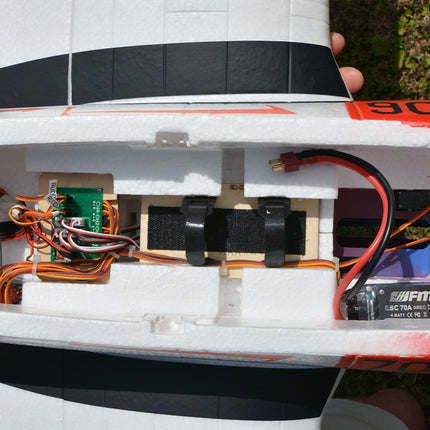
Once the sensor is securely connected to the receiver, you must configure the alarm parameters on your transmitter. A fully charged LiPo cell rests at 4.2V. Permanent chemical damage occurs if a cell drops below 3.0V. Set your transmitter's low voltage warning to trigger at 3.5V or 3.6V per cell. This specific number accounts for "voltage sag" under heavy throttle and ensures the battery recovers to a safe 3.7V resting state after you land the aircraft.
Track Motor Temperature And RPM For Better Performance
High throttle usage generates extreme heat that can easily demagnetize your motor or destroy internal bearings. Tracking these metrics allows you to adjust your flying style or change components before hardware fails.
Placing Temperature Sensors Correctly
Temperature sensors utilize a small physical thermistor loop. To get accurate readings, you must wrap this loop securely around the base of the brushless motor or directly against the aluminum heatsink of the ESC. Secure the sensor with high-temperature Kapton tape to prevent it from shifting during aggressive flight maneuvers. If your transmitter warns you that the motor temperature exceeds 160°F (70°C), you must land immediately to prevent the motor magnets from permanently losing their rotational strength.
Using RPM Data To Select Propellers
RPM sensors calculate exactly how fast the motor spins. This data is crucial for optimizing your aircraft's power system. If you install a larger propeller and notice a massive drop in RPM alongside a rapid spike in motor temperature, the propeller is too heavy for your motor. Tracking RPM allows you to test different propeller sizes to find the perfect, most efficient balance between thrust output and electrical consumption.
Build Your RC Plane Telemetry Setup: Sensors And Receivers
Assembling the hardware requires matching compatible brands and understanding basic circuit wiring. You must select components that speak the exact same protocol to ensure accurate data transmission.
Not all receivers transmit data. You must purchase a receiver that features a dedicated telemetry port. The receiver acts as the central brain of your rc plane telemetry setup, gathering digital data from the sensors and broadcasting it over the radio frequency back to your hands. Using matching protocols ensures the data is not corrupted during transmission.
Traditional setups require you to daisy-chain individual voltage, temperature, and RPM sensors together using multiple cables. Modern Smart ESCs eliminate this clutter. A Smart ESC processes voltage, current, RPM, and internal temperature data simultaneously and sends all of it to the receiver through a single signal wire. This greatly simplifies the wiring process, reduces the overall weight of the aircraft, and leaves much more room in the fuselage for larger batteries.
Read Telemetry Data Safely On Your Transmitter Screen
Looking down at a screen while flying at high speeds causes spatial disorientation and immediate crashes. You must configure your transmitter to deliver data audibly or physically without requiring your visual attention.
Setting Up Voice Alerts And Callouts
The safest way to consume data is through audio. Modern transmitters allow you to program custom logical switches. You can assign a physical toggle switch on your radio to read the current battery voltage out loud when pulled. Furthermore, you can program the radio to automatically announce warnings, such as "Battery Low" or "Motor Critical," whenever the live data drops below the safety thresholds you established. This allows you to fly radio controlled airplanes while keeping your eyes firmly locked on the aircraft in the sky.
Utilizing Haptic Feedback And Vibration
If you fly at noisy club fields or near busy roads, you might not hear the voice callouts clearly. To solve this, link your critical alarms to the transmitter's internal vibration motor. Configure the radio controller to vibrate aggressively when the battery hits 3.5V per cell. The physical sensation in your hands guarantees you will never miss a critical warning, ensuring a safe and perfectly timed landing every time.
Conclusion
Upgrading your radio control system with live data ensures a safer and more precise flying experience. By mastering telemetry technology, you eliminate the risks of unexpected power loss and hardware overheating. Implement these exact steps to monitor battery cells, configure voice alerts, and protect your investments. Fly with absolute confidence knowing your equipment is performing optimally and you have full control over your flight times.
FAQs
Does telemetry reduce my control range?
No. Modern aircraft radio control systems process data on separate, parallel bandwidths or utilize advanced time-slicing protocols. This means your receiver can send live sensor data back to your transmitter without introducing any latency or reducing the maximum distance of your steering commands.
Can I add telemetry to an older RC plane?
Yes. You do not need to buy a completely new airplane. You simply need to replace the old receiver with a modern telemetry-capable unit and plug in a standalone voltage sensor. This instantly upgrades your model to a complete rc plane telemetry setup without rebuilding the airframe.
What is a safe LiPo voltage to land?
When learning how to monitor lipo voltage in flight, you should aim to have your aircraft on the ground when the battery reaches 3.5V to 3.6V per cell under throttle load. Once disconnected, the battery will naturally recover to a resting state of around 3.7V to 3.8V per cell, which is ideal for battery longevity.