
The best beginner RC plane is not simply the cheapest model or the one with the largest wingspan. It must combine predictable handling, repairable construction, durable landing gear, reliable flight stabilization, and readily available replacement parts. A dedicated trainer that matches your local flying field and current skill level will always provide more productive practice than a fragile, high-speed scale model. Use the core features below to evaluate and compare RC planes for beginners before ordering.
Choose a Stable High-Wing Design First
A purpose-built high-wing trainer is the ideal starting point because its airframe geometry is engineered specifically for forgiving, low-speed flight. The operative term is “trainer”—a high wing configuration alone does not guarantee that an airplane will be easy to control.
Look for positive dihedral, gentle control response, a verified beginner rating, a clearly marked center-of-gravity (CG) range, and light wing loading. Dihedral refers to the upward V-angle of the wings when viewed from the front. It delivers essential lateral stability by naturally rolling the aircraft back toward level flight after an upset, as detailed in the FAA's aerodynamics guidance.
Never judge flight stability by silhouette alone. An aggressive scale high-wing warbird with sharp stall characteristics is far more challenging to fly than a true trainer. The Academy of Model Aeronautics (AMA) emphasizes selecting dedicated trainer designs to master takeoffs and landings, while its new pilot guide recommends structured practice and pre-flight checklists.
Look for Durable Foam Construction
A beginner aircraft must withstand minor landing errors and allow straightforward field repairs. While foam is not indestructible, high-density foam significantly reduces the cost and downtime of fixing dings, separated seams, or bent gear mounts.
Why EPO Foam Is the Industry Standard
Expanded Polyolefin (EPO foam) combines low structural weight with impact-absorbing flexibility. Precision-molded EPO components can absorb minor collisions without shattering, making it the premier material for modern electric trainers.
Material performance depends on foam density, internal reinforcement, and structural design. Integrated carbon-fiber wing spars, polymer fuselage bulkheads, reinforced control horns, and heavy-duty hinges are just as critical as the foam itself.
Repairability and Maintenance
Evaluate how easily the airframe can be disassembled. Modular wings, bolt-on landing gear, accessible servo bays, and quick-detach cowlings make maintenance painless.
Always use foam-safe adhesives (such as medium CA or dedicated foam glue) and ensure proper alignment during repairs. Excessive glue adds tail-heavy weight, while misaligned surfaces ruin aerodynamic trim. Always recheck the center of gravity before returning a repaired airplane to the air.
Crash Resistance and Propeller Protection
Durability means an airframe handles repeated transport, hard landings, and assembly cycles without structural fatigue. It is not an absolute safeguard against high-speed impacts.
Propeller configuration also dictates damage risk. A conventional tractor setup (nose-mounted motor) requires careful flare control to avoid prop strikes on nose-over landings, whereas a pusher configuration protects the propeller during rough arrivals. Evaluate the complete design rather than relying on material claims alone.
Landing Gear Makes Everyday Flying Easier
Landing gear directly influences ground steering, takeoff tracking, touchdown stability, and airframe longevity. Tire diameter, track width, nose-wheel steering, and strut suspension must match your actual runway surface.
https://cdn-files.myshopline.com/file/store/1772248208561/1220mm-Ranger-V2-Patented-Durable-Nose-Gear-for-Safe-Landings.mp4
Flying from Grass Fields
Small foam wheels will catch in thick or uneven grass, causing an immediate nose-over on touchdown. Large, oversized wheels and generous propeller ground clearance are essential for short, cut grass strips.
Inspect your runway area before taking off. Check for hidden ruts, sprinkler heads, gravel, and weed clumps. While hand-launching eliminates the ground roll, pilots still need adequate thrust and a smooth clearway to establish positive climb.
Flying from Pavement
Smooth asphalt or concrete minimizes rolling drag and allows a tricycle-gear trainer to track straight with minimal rudder input. However, hard surfaces transmit landing shocks directly into the fuselage mounting structure.
Look for steerable nose gear with integrated spring shock absorption and flexible aluminum or steel main struts. Apply smooth, gentle rudder corrections during the takeoff run to prevent high-speed ground loops as airspeed builds.
Replacement Parts Cost
Landing gear absorbs heavy vertical and side loads, making it the most frequent wear area. Check the availability and pricing of replacement gear sets, steering linkages, and spare tires before committing to an airframe.
Electronic Stability Reduces Pilot Workload
Onboard gyro flight stabilization dramatically lowers pilot workload during initial orientation training. Flight controllers serve as learning aids, not an excuse to fly in adverse winds or tight spaces.
Beginner Flight Modes
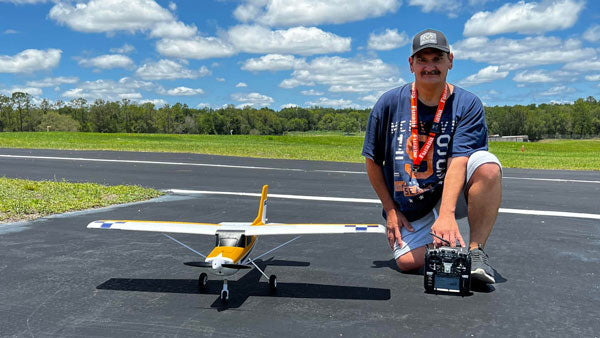
A dedicated beginner mode typically restricts maximum pitch and bank angles while providing electronic auto-leveling whenever the control sticks are centered. Functionality varies across gyro systems, so review the manual thoroughly.
The FMS Reflex V3 gyro system offers three switchable modes: Stabilized (auto-leveling with bank angle limits), Optimized (wind gust damping without angle limits), and Manual (gyro off). Ensure your transmitter flight-mode switch is properly mapped and bench-tested prior to takeoff.
Emergency Recovery Functions
A panic recovery mode requires adequate altitude, flying airspeed, and correct CG balance to right the aircraft. It cannot rescue a low-altitude aerodynamic stall or an out-of-range signal loss.
Practice switching into Stabilized mode at two mistakes high so the response becomes an automatic reflex during unexpected disorientations.
Building Stick Muscle Memory
Use electronic assistance to master rectangular patterns, level altitude turns, smooth throttle management, and flared approaches. As your muscle memory solidifies, step down to Optimized and Manual modes in light wind.
Long-term confidence stems from consistent manual control rather than continuous reliance on gyro auto-leveling.
Do Not Ignore Spare Parts Availability
A beginner trainer is only as good as its parts support. Before purchasing, verify that common replacement components are readily in stock:
- Propellers, spinners, and collet adapters
- Nose-gear assemblies, main struts, and steering arms
- Main wing sets, horizontal/vertical stabilizers, and linkages
- Micro servos, brushless RC plane motors, ESCs, and flight controllers
Always verify part numbers against your specific model version. Keep one or two spare propellers in your field box to avoid cutting a flying session short after a minor prop strike.
How Wingspan and Weight Affect Beginner Flying
Wingspan and all-up weight determine flight stability, gust penetration, transport convenience, and required airspace. Bigger planes generally fly smoother, while compact park flyers offer easy trunk storage.
| Factor | Larger Trainer (1200mm–1400mm) | Micro / Park Flyer (<800mm) |
|---|---|---|
| Visual Orientation | Significantly easier to track at safe training distances | Disorients quickly as distance increases |
| Wind Penetration | Handles moderate breezes with minimal buffeting | Prone to getting tossed around by light wind gusts |
| Transport & Storage | May require quick wing disassembly for transport | Fits fully assembled in any car trunk |
| Flight Space Needed | Requires a standard flying field or open soccer park | Operates comfortably in small neighborhood parks |
| Rough Field Handling | Accommodates larger wheels for varied surfaces | Strictly limited to smooth pavement or hand launches |
| Landing Inertia | Higher mass requires proper flare management | Lightweight inertia minimizes minor impact damage |
Weight alone does not define flight characteristics. Wing area and wing loading dictate stall speed and float. A lightweight model with a large wing area yields a gentle stall and predictable touchdown speed.
Always choose a size that matches your visual acuity and local field boundaries. U.S. recreational pilots must also ensure full compliance with FAA TRUST certification, aircraft registration thresholds, and Remote ID requirements where applicable.
Which FMS Trainer Models Match These Features?
FMS manufactures several purpose-built trainers optimized for different airfield surfaces, pilot preferences, and storage constraints:
| Model | Verified Trainer Specifications | Ideal Pilot Profile |
|---|---|---|
| FMS 1220mm Ranger V2 | 1220mm span, durable EPO high-wing, Reflex V3 gyro, spring-cushioned metal tricycle gear, available in RTF and PNP | The ultimate conventional runway trainer for newcomers seeking easy assembly and docile handling |
| FMS 1300mm PA-18 Super Cub | 1300mm span, functional flaps, CNC metal landing gear, oversized balloon tires, optional water floats | Scale bush-plane trainer ideal for rough grass fields and pilots wanting functional STOL flaps |
| FMS 1400mm Kingfisher | 1400mm span, high-lift airfoil, lightweight EPO build, includes oversized wheels, water floats, and snow skis | The most versatile all-terrain trainer for multi-surface flying across land, water, and snow |
The Ranger V2 represents the quintessential runway trainer. Its tricycle gear provides effortless ground steering, while the Reflex V3 gyro system protects novice pilots from over-controlling.
The PA-18 Super Cub features high-traction balloon tires and functional flaps, allowing short takeoffs and landings on unimproved grass strips without nose-over hazards.
The Kingfisher delivers year-round all-terrain flexibility. With swappable floats, skis, and tundra tires included in the package, it transitions seamlessly across grass fields, lakes, and snow.
FAQs About Beginner RC Plane Selection
Q1. Is an RTF plane better than a PNP plane for a beginner?
Yes. A Ready-to-Fly (RTF) package includes a factory-matched transmitter, receiver, flight battery, and charger, eliminating compatibility guesswork for your first airplane. Plug-and-Play (PNP) models are suited for pilots who already own a compatible radio system.
Q2. Should a beginner start with a 3-channel or 4-channel RC plane?
A 4-channel airplane (throttle, aileron, elevator, rudder) is generally recommended because it teaches complete control coordination from flight one, making future transitions to intermediate sport models seamless.
Q3. Can a beginner fly without an instructor?
Yes, modern gyro-assisted trainers make solo learning practical in calm weather. However, connecting with an experienced club instructor or using a buddy-box system drastically cuts the learning curve and avoids rookie setup errors.
Q4. How much wind is too much for a first flight?
Total beginners should maiden their aircraft in winds under 5 mph (8 km/h). Review our comprehensive RC plane wind limits guide before heading to the field.
Q5. Do beginner RC planes require FAA registration?
Yes, in the United States, any RC aircraft weighing 0.55 lbs (250 grams) or more requires FAA registration and TRUST certification for recreational operations in national airspace.
Use This Checklist Before Buying Your First RC Plane
Select your beginner RC plane based on documented trainer geometry, foam durability, landing gear suitability, gyro stabilization, and reliable parts availability. Verify your field surface and storage space before placing an order. A model engineered for forgiving, predictable practice will consistently deliver a more rewarding flying experience than an advanced plane chosen solely for speed or appearance.