
Have you ever wondered why some RC planes float gently like a feather while others scream through the sky like a missile? The secret lies in the wings. Understanding RC plane aerodynamics is the single most important step toward becoming a better pilot. It is not just about pulling back on the stick; it is about understanding the physics keeping your aircraft aloft. This guide will demystify how wing shapes and airfoils control everything from a gentle trainer flight to aggressive 3D maneuvers, giving you the knowledge to choose and fly your next model with confidence.
What Are the Four Fundamental Forces of Flight
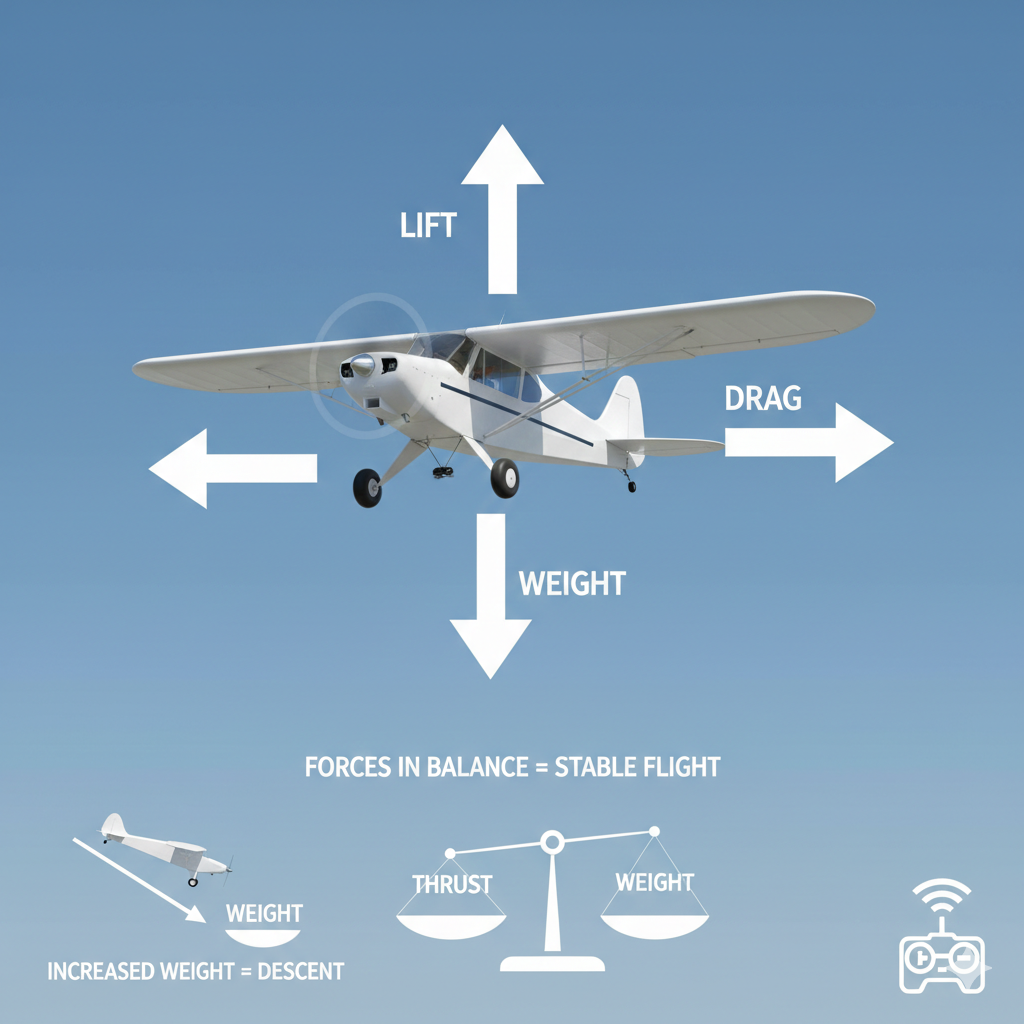
Before we dissect the wing itself, we must understand the battlefield where your RC plane operates. Every second your model is in the air, it is caught in a tug-of-war between four invisible forces: Lift, Weight, Thrust, and Drag.
Lift acts upward, fighting against Weight (gravity), which pulls the plane down. To climb, the lift must exceed the weight. Thrust, generated by your motor and propeller, pulls the plane forward. Opposing this is Drag, the air resistance, trying to slow the plane down.
For an RC plane to maintain steady, level flight, these forces must be in balance. The wing's primary job is to generate enough lift to counteract the weight of the battery, motor, and airframe. Understanding this balance is the first step in mastering RC flying. If you add a heavier battery (increasing weight) without changing the wing or speed, your plane will descend because lift is no longer sufficient.
How Does an RC Plane Wing Generate Lift?
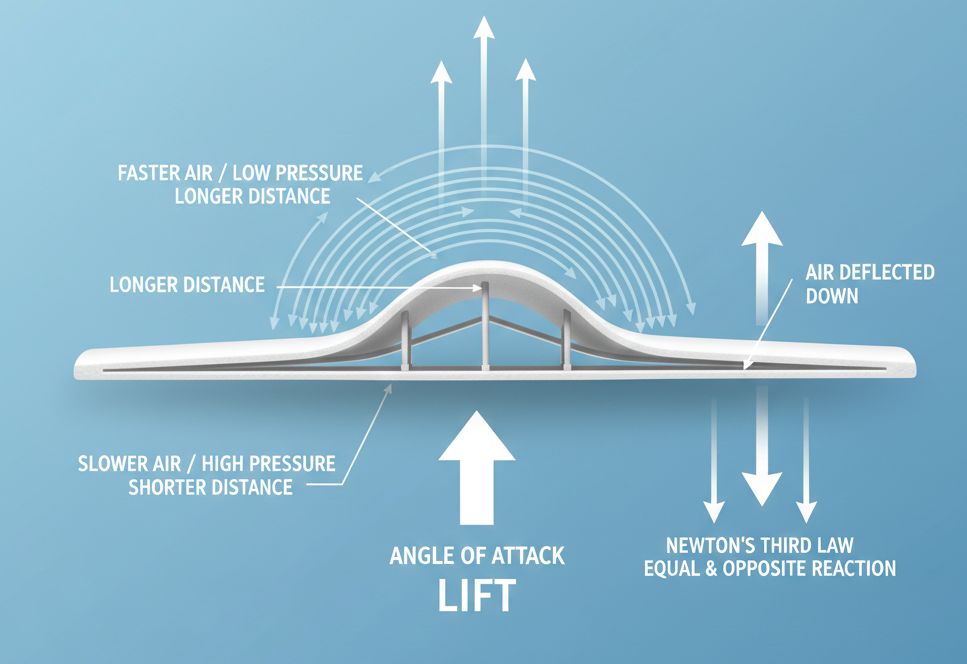
So, how does an RC plane wing generate lift? It is not magic; it is pressure physics. As the wing slices through the air, it splits the airflow. The top surface of the wing is curved, forcing the air to travel a longer distance over the top than the bottom to reach the trailing edge at the same time.
According to Bernoulli's principle, this faster-moving air over the top creates an area of lower pressure compared to the slower-moving, higher-pressure air underneath the wing. This pressure difference literally sucks the wing upward.
Additionally, Newton's Third Law plays a role. As the wing moves forward, it is angled slightly upward (angle of attack), deflecting air downward. The equal and opposite reaction pushes the wing up. Both principles work together to keep your RC plane in the sky.
A Closer Look at the Airfoil Profile
If you cut a wing in half from front to back, the cross-section shape you see is called the airfoil. This specific shape dictates the plane's personality.
- Leading Edge: The rounded front part of the wing that hits the air first.
- Trailing Edge: The sharp rear point where the airflow rejoins.
- Chord Line: An imaginary straight line connecting the leading and trailing edges.
- Camber: The curvature of the wing's surfaces.
A wing with a high camber (very curved on top) generates massive lift at low speeds, perfect for gliders or heavy cargo planes. A wing with little to no camber generates less lift but produces much less drag, allowing for higher speeds. When building flying model aircraft kits, paying attention to the airfoil shape will tell you exactly how that model is intended to fly before you even glue the first piece.
Flat-Bottom vs. Symmetrical Airfoils: What's the Difference?
When shopping for RC airplanes and parts, you will primarily encounter two main airfoil types. Understanding the difference is crucial for your piloting progression.
The Flat-Bottom Airfoil
As the name suggests, the bottom of this wing is flat, while the top is curved. This design is a lift-generating machine. It creates lift even when the wing is flying perfectly level. This is the standard for high-wing trainers and Piper Cub-style planes. It provides excellent stability and allows the plane to fly slowly without stalling. However, if you try to fly inverted (upside down), a flat-bottom wing will fight you, requiring massive down-elevator to stay level.
The Symmetrical Airfoil
In this design, the top and bottom curves are identical. A symmetrical airfoil generates zero lift at a zero-degree angle of attack. To create lift, the pilot must angle the wing slightly upward. This is the gold standard for RC plane wing design for aerobatics. Because the shape is the same on both sides, the plane flies exactly the same upside down as it does right side up. It is less stable than a flat-bottom wing but offers the precision required for loops, rolls, and 3D flying.
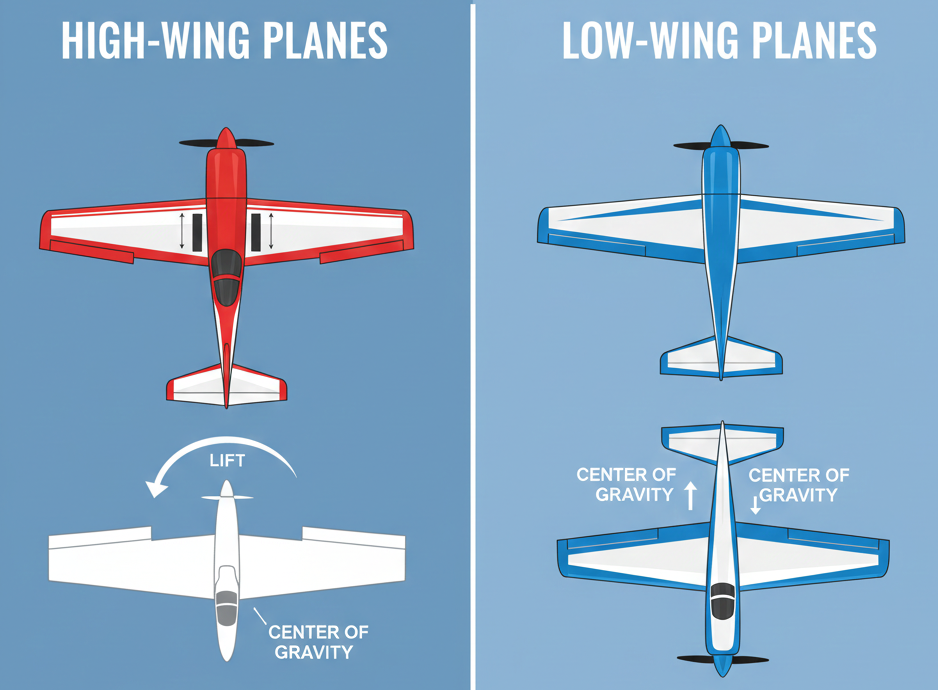
How Wing Placement Affects Your Plane's Stability
The vertical position of the wing relative to the fuselage significantly impacts how the plane handles. This is why trainers look different from fighter jets.
High-Wing Planes
Most trainers place the wing on top of the fuselage. This puts the plane's center of gravity (the heavy stuff like the battery and motor) below the wing. It acts like a pendulum. If the plane gets tipped by the wind, gravity naturally wants to pull the fuselage back to a level position. This self-correcting trait is invaluable for beginners learning the basics of RC flying.
Low-Wing Planes
Placing the wing on the bottom of the fuselage moves the center of gravity closer to the lift point. This makes the pendulum effect disappear. The plane becomes less stable but much more responsive. It will go exactly where you point it and stay there until you tell it to move again. This is preferred for sport flying and aerobatics but requires a pilot who is constantly active on the sticks.
Wing Loading and Its Impact on Flight
One of the most critical specs to look at is wing loading on an RC plane. This is a simple calculation: the total weight of the plane divided by the total surface area of the wing. It is usually measured in ounces per square foot (oz/sq ft).
Low Wing Loading
Think of a glider or a light trainer. It has a large wing area relative to its weight. These planes are "floaty." They can fly very slowly without stalling, land gently, and are forgiving of mistakes. However, they get tossed around easily by the wind.
High Wing Loading
Think of a scale warbird or a jet. These planes have small wings supporting a heavy body. To generate enough lift to stay airborne, they must fly fast. They penetrate the wind well and track smoothly, but they have a high stall speed. If you slow down too much on landing, a plane with high wing loading will drop out of the sky like a stone.
Dihedral, Anhedral, and Swept Wings Explained
Beyond the airfoil and placement, the angle of the wings themselves changes the flight physics.
Dihedral
Look at a trainer plane from the front. You will notice the wings form a shallow "V" shape, angling upward from the fuselage. This is Dihedral. It creates roll stability. If a gust of wind banks the plane to the left, the lower wing generates more lift than the higher wing, automatically rolling the plane back to level.
Anhedral
This is the opposite, wings that point downwards. This kind of aircraft design occurs rarely, mainly on freighters and high-performance aircraft. This design deliberately creates instability during the rolling of the aircraft, which enhances quick flight maneuvering.
Swept Wings
Wings that point back, similar to jet aircraft, are designed for optimal speed. These wings produce less drag as the plane travels faster. Consequently, there could be the problem of 'tip stalling,' which makes landing difficult. For most propeller-driven remote control airplanes and components, the straight wings provide the most optimal balance of both lifting and stability characteristics.
Choose the Right Wing for Your Flying Style
To begin, the choice of the aircraft begins with an honest evaluation of yourself. As a new model airplane user, the last plane you ought to consider is a symmetrical-wing jet. What you need is the high wings of the trainer, which sport the flat-bottom airfoil and copious dihedral. This design will fight the wind for you and self-correct when you let go of the sticks.
If you are ready for your second airplane, look for one that is a low-wing sport plane. This airplane sports a semi-symmetrical airfoil and moderate wings. This airplane will allow you to learn how to do some basic stunts, like rolling and looping, without the punishing speed of a warbird
For the sporty pilot, for the adrenaline junkie, there are RC airplane wings for aerobatics, designed for advanced pilots. These wings use symmetric foils, no dihedral, and oversized control surfaces. Match your skill levels to the design, and every flight becomes one of triumph, not repair.
FAQ
Can I change the airfoil on my RC plane?
Typically, no. The airfoil would be incorporated into the structure of the ribs of the wings and the foam molds. Modifications would require making an entirely new wing from the start. In fact, it would be simpler to purchase an aircraft that meets the flight performance that you desire.
Does a heavier plane always need a bigger wing?
No. A heavy aircraft must either have an oversized wing or be fast enough to develop the same amount of lift. This explains why an oversized jet airplane has small wings and powerful engines. They rely on speed to stay airborne.
What happens if the wing loading is too high?
The aircraft becomes very difficult to control. The aircraft's stall speed becomes high, and as such, you would land the aircraft very fast. This aircraft would not be very agile during tight turning, and it would suddenly 'snap' out of the air if you used too much elevator.
Why do some aerobatic planes have flat wings with no airfoil?
Some "Shock Flyers" or indoor 3D foam planes use a flat plate wing. These airplanes rely solely on the angle of attack and the powerful motor for flight. They are extremely agile but inefficient and create much drag. This means they are unable to glide.