

A 1/24 crawler is usually the better choice for indoor courses, while a 1/18 crawler is generally more capable on backyard routes and light outdoor trails. In a 1/24 vs 1/18 RC crawlers decision, the best scale is the one that fits your available space, typical obstacles, and willingness to carry a larger vehicle. Both can suit a beginner, but they create different challenges. The smaller truck makes household objects feel substantial. The larger truck crosses rougher ground with more stability and clearance.
Scale Size Changes How Crawlers Perform
Scale changes how a crawler responds to obstacles because it affects the vehicle's physical dimensions, weight, wheelbase, tire size, and clearance. A 1/18 model is nominally larger than a 1/24 model, but the scale label alone does not reveal every measurement. Body proportions and chassis design vary, so compare the actual specifications of the models on your shortlist.
How Scale Affects Weight and Handling
A larger crawler often feels more settled over bumps, while a smaller model reacts more sharply to tiny surface changes:
| Handling Factor | Typical 1/24 Effect | Typical 1/18 Effect |
|---|---|---|
| Weight | Portable; less pressure on loose ground | More planted on firm ground |
| Footprint | Fits tight turns and narrow gates | Bridges wider gaps |
| Obstacle scale | Small objects become useful tests | Small objects feel less demanding |
| Balance | Reacts quickly to bumps | Benefits when weight stays low |
Scale does not determine handling by itself. Weight distribution, tires, suspension, gearing, and body height still matter, so a top-heavy 1/18 crawler may tip where a balanced 1/24 model remains composed.
Why Smaller Crawlers Fit Different Environments
A smaller crawler needs less floor area and makes ordinary objects feel larger. This supports more route choices in a modest room.
- Tighter layout: Short approaches and narrow turns fit limited space.
- Useful obstacles: Pencils, books, and towels can test clearance.
- More choices: One area can hold several alternate lines.
Indoor crawler size should be considered alongside total course area. A proper setup leaves sufficient room for approaches, recovery, and alternate lines.
1/24 RC Crawlers Excel in Small Spaces
A 1/24 crawler is the default for apartments, offices, and temporary courses. Its compact footprint makes setup easier, and household materials can form a low-speed route without a dedicated hobby room.
.jpg?w=3072&h=1728)
Indoor Obstacles and Home Courses
Books, foam blocks, cardboard, towels, and low wooden strips can create climbs, bridges, off-camber sections, and narrow gates. Keep the route away from stairs, fragile objects, pets, and loose cords. Use stable materials and avoid stacking heavy items where a bump could make them fall.
Course design should test control instead of relying only on height. A varied home route can combine three compact challenges:
- A tight turn before a low ramp
- A diagonal crossing over a folded towel
- Two possible lines around the same obstacle
Enough open space should remain for safe retrieval, and every obstacle should stay stable if the crawler bumps it. These choices create variety without turning the room into a permanent course.
A small RC crawler for home use is practical when the course must disappear after a session. Lightweight pieces can share one storage bin and form a different route next time.
Benefits of Compact Dimensions
Compact dimensions improve portability and storage. A 1/24 model and its equipment need less shelf and carrying space than a larger rig, though the exact fit depends on the body and accessories.
The FMS 1/24 collection shows why buyers should compare exact models rather than assume every 1/24 crawler has the same proportions or equipment. According to current product information, one example, the FMS FCX24S Power Wagon S RTR, includes a two-speed transmission, portal axles, four-link suspension, a 130 brushed motor, a 7.4V 380mAh battery, and a USB battery charger. These features are relevant to a buyer who wants an included driving system and selectable gearing in a compact crawler.
Compact size still brings tradeoffs. Small screws and connectors can be harder to handle, while minor outdoor debris can catch an axle or steering link. Always review the product manual before charging, cleaning, or making adjustments.
1/18 RC Crawlers Add Outdoor Capability
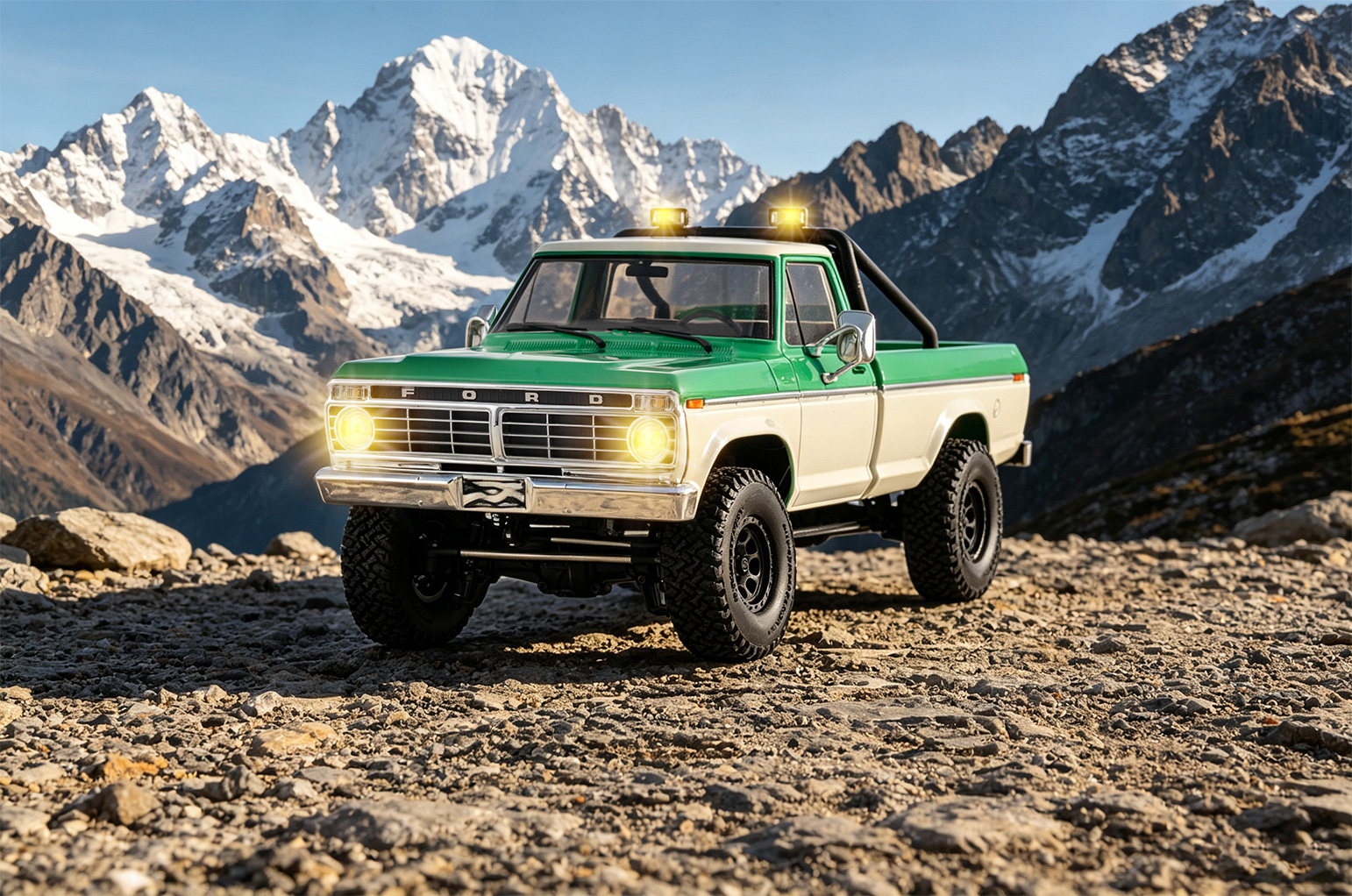
A 1/18 crawler is usually the better choice when outdoor driving is the priority but a 1/10 rig would be too large. Its larger footprint can bridge wider gaps, roll over bigger surface changes, and remain calmer on uneven ground. It still needs terrain selected for a mini crawler rather than a full-size trail truck.
Better Stability on Uneven Surfaces
The typical 1/18 crawler places its tires farther apart and spans more ground between the axles than a smaller counterpart. On packed soil, roots, and uneven patio edges, that geometry may reduce how sharply the chassis pitches and rolls over each feature.
Stability is not guaranteed by scale alone. A tall hard body, roof accessories, or weight mounted high can raise the vehicle's center of gravity. Tire grip and suspension setup also affect how the truck holds a line. When comparing models, look at actual width, wheelbase, tire diameter, body height, and where the battery sits. Drive slowly across side slopes and turn downhill if the body begins to lean excessively.
For 1/18 crawler outdoor performance, surface choice remains important. A suitable first route usually has firm features that match the vehicle's dimensions:
- Compact soil rather than deep loose sand
- Flat stones rather than large jagged rocks
- Small roots and controlled grades rather than tall grass
These conditions give the crawler room to use its larger footprint without making debris the main obstacle. More difficult surfaces can be added after the driver understands the model's clearance and balance.
More Ground Clearance for Trails
A larger model often has taller tires and more ground clearance under the chassis or axle housing, helping it pass over sticks and stone edges that would catch a smaller truck. The useful number is the exact model's measured clearance, not the scale label. Portal axles, tire diameter, differential shape, and suspension links all influence where the vehicle may hang up.
Clearance must be balanced against stability. Raising a body or chassis can increase rollover risk. Wheelbase and approach or departure angles also affect where a vehicle contacts a sharp obstacle.
Browse the FMS 1/18 collection to compare current body styles and model-specific equipment. Do not assume that a motor type, axle design, battery, or water-resistance statement applies across the entire scale. Confirm each feature on the exact product page, particularly if your route includes damp ground or if you plan to replace parts later.
Your Driving Environment Determines the Better Choice
Choose 1/24 for frequent indoor driving and 1/18 for regular outdoor use on appropriately sized terrain. For mixed use, check whether the indoor space can accommodate the larger turning and recovery area before buying.
| Decision Factor | 1/24 Crawler | 1/18 Crawler |
|---|---|---|
| Best starting environment | Apartment, office, tabletop, or compact floor course | Backyard, patio, or light mini-crawler trail |
| Course materials | Books, foam, cardboard, towels, and small ramps | Flat stones, compact soil, small roots, and low garden features |
| Space requirement | Lower, with tighter turns and shorter approaches | Higher, with more room for turns, run-up, and retrieval |
| Outdoor obstacle tolerance | Better on smooth rock and small, firm features | Better on moderate bumps, gaps, and uneven surfaces |
| Portability and storage | Easiest to carry and store | Still portable, but needs a larger case and shelf area |
| Main limitation | Light weight and low clearance on loose or coarse terrain | Can feel oversized on a small indoor course |
Choose for Indoor Driving
Start with the room, since a few measurements make the scale decision clearer:
- Measure the longest usable lane.
- Check the narrowest turn between fixed objects.
- Reserve an open area for safe retrieval.
A 1/24 truck is usually the best RC crawler scale for beginners who will practice at home because it creates more driving decisions in a smaller footprint. It also makes modest obstacles challenging enough for slow, deliberate control.
A 1/18 model can work indoors in an open basement, garage, or dedicated room. Use broader turns and longer approaches, then add challenge through gates, side slopes, and route choice.
Noise and cleanup may also affect the choice. A removable mat, clean tires, and lightweight foam obstacles help protect floors. Always store batteries and chargers according to manufacturer instructions.
Choose for Outdoor Adventures
- Pick 1/18 when most sessions will use backyard stones, compact trails, or uneven patios. The larger tires and footprint of many 1/18 designs give you a wider selection of usable lines before ordinary debris becomes the dominant challenge. Carry the model to the intended area before switching it on, and inspect the route for water, sharp objects, people, and animals.
- Pick 1/24 outdoors when portability matters most or when you can choose smooth, small-scale terrain. Flat rock, dry packed soil, and a purpose-built mini course can be rewarding, while grass stems and loose stones may dominate a natural route.
For mixed use, prioritize the environment you can access most often. A larger crawler offers little value if it rarely fits the space, while a small truck may disappoint on coarse gravel and tall grass. Frequency, storage, and terrain should carry more weight than the scale number alone.
Compare Your Crawler Needs Before Buying
The right purchase depends on more than indoor versus outdoor use. Compare actual dimensions, included equipment, parts access, control features, and the surfaces you expect to drive. Scale is a useful first filter, but two models in the same class can have different wheelbases, bodies, axles, tires, and electronics.
To navigate these variables and make the best choice, follow these practical steps:
- Decide whether you want a complete ready-to-run package or a model that needs separate equipment.
- Check what comes in the box, what transmitter batteries are required, and whether the supplied charger matches the included battery.
- Confirm replacement parts are listed for the exact chassis and version. Similar model names do not guarantee compatibility.
- Set a total budget that includes the vehicle, storage, approved charging accessories, course materials, and commonly replaced parts. For a beginner, reliable low-speed control and model-specific instructions often matter more than maximum speed.
Once product details are verified, this separate buying sequence helps turn the comparison into a decision:
- Choose the environment you will use most often.
- Measure the available course, storage, and transport space.
- Compare exact dimensions and clearance for shortlisted models.
- Verify box contents, battery requirements, and parts pages.
- Select features that solve a real need on your route.
If the answers consistently point toward tight rooms and temporary courses, choose 1/24. If they point toward backyard routes and rougher small-scale terrain, choose 1/18. For a first crawler, regular access to a suitable course is more valuable than buying the larger scale by default.
Find the Right Scale for Your Route
Use your real driving space to settle the 1/24 vs 1/18 RC crawlers choice. A 1/24 model brings technical crawling into smaller rooms and packs away easily, while a 1/18 model gives you more options on uneven backyard surfaces and light trails. Measure the course, compare exact product specifications, and verify what is included before ordering. Then explore current FMS crawler options in the scale that matches the terrain you can enjoy most often.
Frequently Asked Questions
Q1. Can a 1/24 RC Crawler Drive Outside?
Yes, if the route uses smooth rock, packed soil, or other small, firm obstacles. Tall grass, deep loose material, and large gaps can stop a 1/24 crawler quickly.
Q2. Is a 1/18 Crawler Too Large for an Apartment?
Sometimes, depending on the available floor area and course design. It can work in an open room, but a 1/24 model usually allows more turns and obstacle choices in the same space.
Q3. Do Scale Labels Guarantee a Crawler's Dimensions?
No, because modeled full-size vehicles and body proportions differ. Always compare the listed length, width, height, wheelbase, tires, and clearance of the exact products.
Q4. Should a Beginner Choose an RTR Crawler?
Usually, when the box includes the vehicle, radio system, battery, and suitable charger. Check the exact contents and any transmitter batteries still required before buying.
Q5. Can 1/24 and 1/18 Crawlers Share a Course?
Yes, if the course provides alternate lines sized for each vehicle. Use narrower gates and smaller obstacles for 1/24, plus broader turns and larger features for 1/18.