
Is your RC car spinning out in tight turns or flying off wackie jumps uncontrollably? A properly set up suspension is the key to unlocking its ultimate capability. Learning your shocks, springs, and mounting points can change your unpredictable handling to precise, stable control. In this guide, we demystify the suspension tuning process so that you can achieve more grip, improved control, and most importantly, more fun, no matter the surface. Dive on in and get your car dialed.
Know the Fundamentals of Your RC Suspension
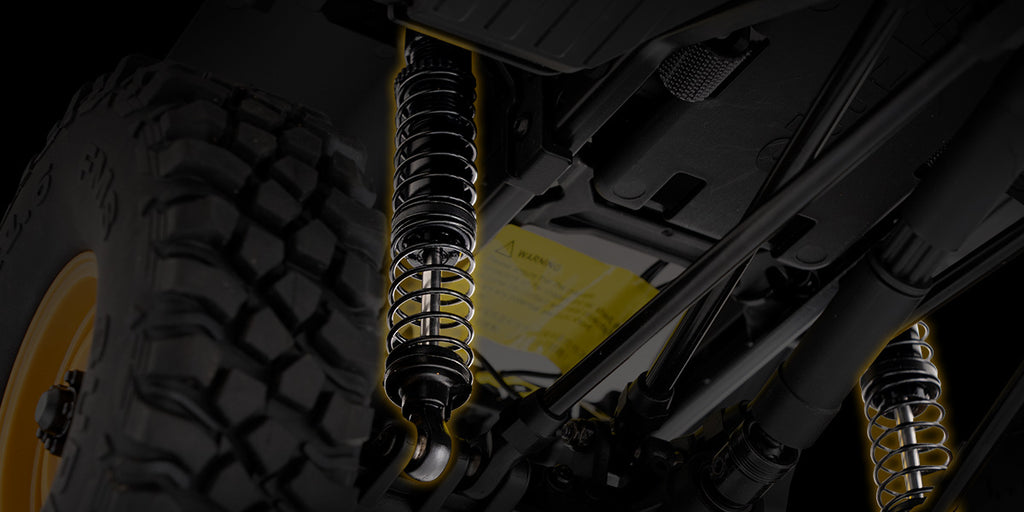
To set up your suspension on your RC car, first, you need to know what your suspension does. It has two main jobs. It breaks up bumps so the tires remain on the ground for best traction, and it determines where the mass of the car goes as you accelerate, brake, and corner. A good suspension setting gives you an easy-to-predict car that is stable, so you're happy to drive the car faster.
The primary parts that you will work with are the shocks. They come equipped with a shock body, piston, shock oil, and a spring. These pieces interact with the suspension arms as well as the shock towers to regulate the movement that the car experiences. It is all about making the pieces interact properly, even if running a fast-brushless-motor RC car or tackling a harsh trail. It is now easy to get started, more so with brands such as FMS that provide enjoyable experiences. You, for example, may receive an offer where the purchase of the car entitles you to the accessories for free, or seasonal items such as Halloween stickers, so that the customized car is ready immediately.
How to Tune Your RC Suspension with Shock Adjustments
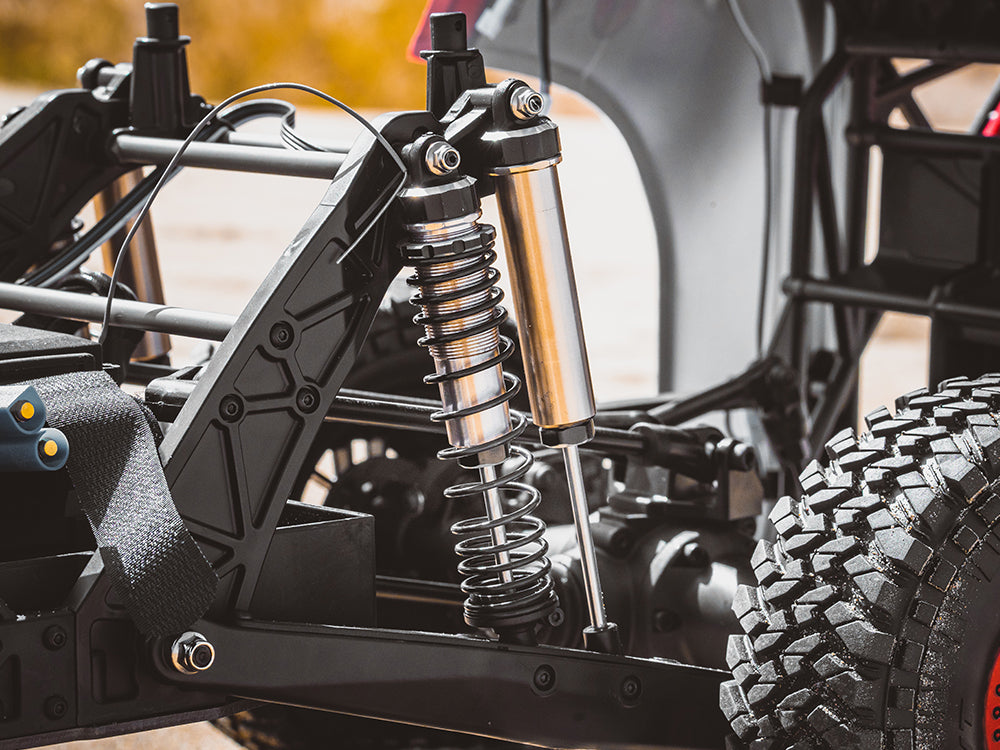
The simplest and most frequent upgrades are done directly on the shocks. These upgrades will have the largest impact on the manner in which your vehicle rides and are the best place to begin.
Adjust Your Ride Height
Ride height is the distance the master frame of your car is off the ground. It changes your car's center of gravity as well as the path your car follows up bumps, as well as over jumps. It may be changed by turning the preload collars on the shocks. Rotating the collar downwards will compress the spring, increasing the ride height. Rotating the collar clockwise has the opposite effect.
A lower riding height provides improved cornering capability across smooth, high-grip tracks. It achieves this as it keeps the vehicle center low and prevents the body from rolling too intensely in the corner. It is best to be high off the ground over rough terrain, as this provides the suspension time to soak up bumps before touching the ground. A 1/10th RC car would be a reasonable place to begin with the suspension arms parallel to the ground. An RC Trophy Truck 1/10th style car will be significantly higher as it needs to be capable of handling larger bumps.
Change Your Shock Oil (Damping)
Damping controls how fast your suspension moves up and down. This is controlled by the thickness of the shock oil. Thicker oil adds more damping and slows down the suspension. Thinner oil lets it move faster.
- Thicker Oil: This slows down the shock. It makes the car feel more stable and less bouncy on smooth tracks with big jumps or fast turns. But on very bumpy tracks, it can make the wheels bounce over bumps because the suspension can't move down fast enough.
- Thinner Oil: This lets the suspension move quickly. It helps keep the tires on the ground on rough tracks. The downside is that the car might feel less stable on high-grip tracks and can hit the ground on big jumps.
Swap Your Springs
The springs support the weight of the car and regulate how much the body leans during turns. Springs vary in their degree of firmness. Changing the spring is a significant modification that significantly alters how your car handles. It is a very significant component of all adult-sized RC cars.
Soft springs allow the body of the car to roll more. This would provide more grip on dirty or slippery tracks, but would potentially make the car slow to respond. Stiffer springs do not allow the body to roll as much. This will make the car faster-feeling and quicker to respond on high-grip tracks. Stiffer springs, though, would also tend to decrease your overall traction on bumpy tracks as they do not absorb bumps as much.
How to Tune by Changing Shock Mounting Positions
A smaller, but still powerful, way to tune your car is to change where the shocks are mounted. You can change the top position on the shock tower and the bottom position on the suspension arm. These changes adjust the angle of the shock. This changes how it works and how much stiffer it gets as it moves.
Adjust the Top Mounting Position (Shock Tower)
Moving the top of the shock changes how the suspension feels as it compresses. A "progressive" suspension gets stiffer as it is pushed down.
- Standing the Shock Up (Moving In): Mounting the shock closer to the middle of the tower makes it more straight up and down. This makes the suspension feel less progressive. The car will feel a bit stiffer at first and will react more quickly to steering. This is usually better for smooth, high-grip tracks.
- Laying the Shock Down (Moving Out): Mounting the shock farther out on the tower makes it sit at a bigger angle. This makes the suspension more progressive. It feels softer at first but gets much stiffer as it is pushed down. This is great for bumpy ground and big jumps.
Adjust the Bottom Mounting Position (Suspension Arm)
Moving the bottom of the shock mostly changes the damping and spring feel. It does not change the progressive feeling as much as the top mounts do.
- Moving the Shock Out: Mounting the shock farther out on the arm makes the suspension feel stiffer. Your damping and spring will have a bigger effect. The car will feel more responsive, but it may have less grip on bumpy surfaces.
- Moving the Shock In: Mounting the shock closer to the car's body makes the suspension feel softer. The car will have more body roll and usually more traction, especially on loose surfaces. A good example is an RC rock crawler, which often mounts the shocks close to the body to let the suspension move and flex as much as possible.
How Shock Mounting Adjustments Influence Your RC Suspension Setup
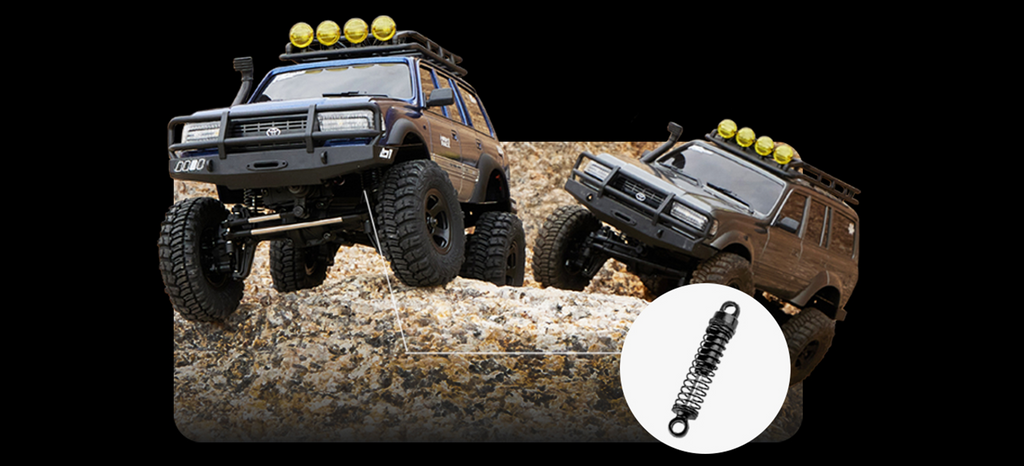
It is very important to know that all these adjustments work together. For example, if you lay the shocks down on the tower to make them feel softer, you might need to use thicker shock oil or a stiffer spring to balance it out. The goal is to find a setup that works for you and the track.
The best way to do this is to make only one change at a time:
- Take your car for a drive and feel the difference.
- Decide if it was a good change.
If you change the oil, springs, and mounting spots all at once, you won't know which change caused the different handling. It helps to keep a notebook to write down your changes and the results.
A Final Thought on RC Suspension Tuning
Tuning is something you keep doing by testing and making small improvements. There is no one "perfect" setup because the best setup will change with different tracks and conditions. The tips in this guide will work for almost any hobby rc car and should give you a good starting point. Start with the basics, make small and careful changes, and pay attention to how your car feels. Soon, you will start to get a feel for what your car needs to drive its best.