
Taking the controls of a radio-controlled airplane for the first time is an unforgettable thrill. But for many newcomers, that excitement is quickly met with the challenge of keeping the aircraft stable. Modern technology, however, has introduced a game-changing tool that acts as a digital co-pilot for new aviators. This guide will explain the magic of the RC plane gyro and how RC plane flight stabilization systems are helping more beginners than ever achieve success in the sky.
What Is an RC Plane Gyro?
At its core, an RC airplane gyro, or flight stabilizer, is a small electronic device that works tirelessly to keep your plane flying smoothly. Think of it as an invisible co-pilot constantly making tiny corrections. The gyro contains advanced sensors (accelerometers and gyroscopes) that can detect any unintended movement of the aircraft in three dimensions: roll (wing tipping), pitch (nose up/down), and yaw (nose left/right).
When the sensors detect a movement that was not commanded by the pilot—such as a wing dipping in a gust of wind or the nose pitching up too steeply—the gyro instantly sends a signal to correct it. It acts as a stabilizing force, constantly working in the background to maintain the plane's intended attitude.
How Stabilization Creates a More Forgiving Aircraft
The primary job of a flight stabilizer is to make the airplane easier and more predictable to fly, which is a massive advantage for a beginner. The system achieves this by automatically making thousands of tiny, rapid adjustments to the plane’s control surfaces (the ailerons, elevator, and rudder) every second.
These corrections are faster and more precise than any human pilot could make. If a sudden gust of wind tries to roll the plane to the right, the gyro will instantly apply a touch of left aileron to counteract it, often before the pilot even notices the disturbance. This creates a much smoother and more stable flight path, giving the beginner pilot more time to think and react.
Conquer Wind and Unpredictable Air
One of the biggest challenges for any new RC pilot is dealing with wind. A light breeze that feels pleasant on the ground can be a turbulent force for a lightweight RC plane. This is where a gyro is most valuable.
Without a stabilizer, a beginner pilot must constantly fight the wind, making continuous adjustments to keep the wings level and the nose pointed in the right direction. A gyro-equipped plane, however, does most of this work for you. It automatically counters the effects of gusts and crosswinds, making the aircraft feel as if it is flying on a calm day. This allows new pilots to learn in less-than-perfect conditions without being overwhelmed.
Prevent Over-Control and Common Beginner Mistakes
New pilots, nervous on the sticks, often make the mistake of "over-controlling" their aircraft. They react to a small dip of a wing with an abrupt, exaggerated stick movement, which causes the plane to bank sharply in the other direction. This can lead to a dangerous cycle of over-correction that can quickly result in a loss of control.
A gyro system helps to dampen these harsh inputs. While it still allows the pilot to command a turn, it smooths out the response, preventing the plane from reacting too erratically. Many beginner modes also limit the maximum bank and pitch angles, making it physically impossible for a new pilot to put the plane into a dangerous dive or an unrecoverable spin.
Understand Different Flight Stabilization Modes
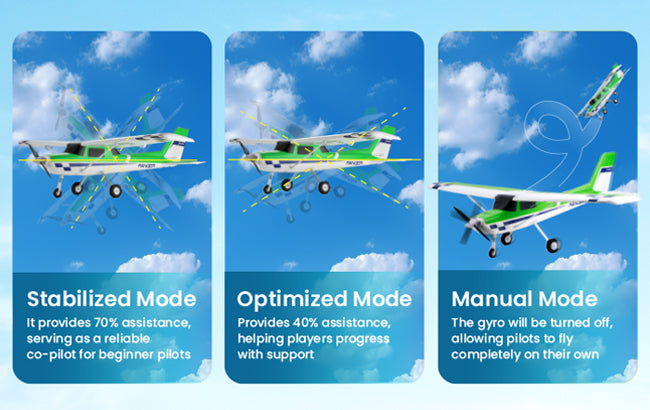
Not all stabilization is the same. Most modern beginner RC aircraft with a gyro feature have selectable flight modes, allowing the pilot to reduce the level of assistance as their skills grow. A great example of this is the FMS Reflex V3 Stable Flight Controller, which offers an excellent three-mode setup. This "co-pilot" system gives beginners the confidence to fly while minimizing risks.
The typical three-mode system includes:
- Beginner/Stabilized Mode: This mode offers maximum assistance. It will often limit the bank and pitch angles of the plane to prevent over-control. Crucially, if the pilot gets disoriented, they can simply release the control sticks, and the gyro will automatically return the plane to straight-and-level flight.
- Intermediate/Optimized Mode: In this mode, the gyro's assistance is less intrusive. It will no longer self-level the aircraft, but it will still actively work to smooth out turbulence and gusts of wind. This allows the pilot to perform more advanced maneuvers while still benefiting from the gyro's stabilizing influence.
- Expert/Manual Mode: In this mode, the gyro is turned off completely. The pilot has full, unfiltered control of the aircraft, just as if no stabilizer were installed. This is the final goal for any pilot who wants to master the hobby.
Can You Add a Gyro to Any RC Plane?
This is a common question from hobbyists who own a non-stabilized plane and want to make it easier to fly. The answer is yes, you absolutely can. There are two main ways to get a gyro into your aircraft.
The easiest way is to purchase a beginner RC plane with gyro technology already integrated into the receiver. These "all-in-one" systems are designed to be plug-and-play and are perfectly tuned for the specific aircraft they come with.
Alternatively, you can buy a standalone RC airplane gyro unit. These are small devices that are installed between your receiver and your servos. They require a bit more setup and tuning, but they offer the flexibility to add stabilization to virtually any RC plane in your fleet.
Building Confidence and Accelerating Your Skills
Perhaps the greatest benefit of RC plane flight stabilization is the confidence it inspires. Learning to fly can be an intimidating process, and the fear of crashing a brand-new plane can cause a lot of anxiety. A gyro acts as a safety net, dramatically reducing the number of crashes caused by common beginner mistakes.
This safety net allows a new pilot to relax and focus on learning the fundamentals of flight, such as controlling orientation, managing throttle, and practicing basic maneuvers like turns and figure-eights. By minimizing the stress and maximizing the "stick time," a gyro-equipped plane helps beginners become better pilots, faster.
Is a Gyro-Equipped Plane Right for You?
For anyone new to the world of radio airplanes for beginners, the answer is an unequivocal yes. Starting with a beginner RC plane with a gyro is one of the surest ways to ensure your first experience in the hobby is a positive and successful one. It makes the learning curve less steep, builds confidence quickly, and protects your investment from avoidable crashes. It is the single most effective tool for helping a beginner succeed.
Conclusion
The RC plane gyro has revolutionized the hobby for beginners in a radical new way. It is absolutely not something used because one is too lazy to learn; rather, it is an educational tool in itself, one that teaches quickly because of its amazing qualities. This device is what takes away the aggravation of learning and introduces a beginner to the pure joy of flight from the very beginning!

FAQ
Will flying with a gyro prevent me from learning how to fly properly?
Rather, it is the opposite of what you described in your question. A gyro with the ability to switch modes is a flight instructor. It assists you in your learning process because you begin with a beginner mode with a safety net and advance to an intermediate mode where you eventually turn off the gyro itself.
Do expert pilots ever use gyros?
Yes, they do. Though they may not use the beginner modes with self-leveling features, the expert pilots will use the intermediate level, commonly called the “optimized” mode, often when it is windy and especially when flying the smaller planes.
Does a gyro make the plane fly by itself?
No. A gyro is a stabilization device, and an autopilot is something entirely different. You can control where you want the plane to go, and the gyro will help it fly nicely on that path you've directed it to follow.
Are gyros difficult to install in a plane that doesn't have one?
The actual process of installing a standalone gyro is relatively simple for a person who has some expertise in RC construction. It requires you to simply plug the gyro in between your receiver and your servos and install it the right way in your plane. But if you are a beginner, it is always advisable to begin with an RC plane designed for a beginner with a built-in gyro set up by the manufacturer.